
If you don’t correctly work out the EMI for a business loan before taking on debt, you’re going to put your brand in a position where it will suffer severe financial consequences. Although scaling an online shop seems very impressive when it’s posted on Twitter, the actual situation behind the scenes is harsh. While debt can be a powerful means of achieving growth, it is also the quickest way to drive your LLC into bankruptcy should your cash flow forecasts be inaccurate.
When I was starting out, my agency obtained a large working capital loan of six figures in order to strongly back our own e-commerce operations. Having looked at our total revenue we thought that we would have no difficulty meeting the monthly payments. We were entirely mistaken.
We never considered the effect of compound interest and the declining ROAS (Return on Ad Spend) as our business grew. Our cash reserves were being used up very quickly within three months and so we had no choice but to stop all our ad campaigns in order to meet our bank payments.
To fix this fatal error, I built the Dixtify Free Calculator—specifically our internal EMI mapping tool—to visualize exact monthly liabilities against our projected revenue. I am sharing this exact tool for free today because guessing your debt costs is absolute financial suicide. You must know your numbers down to the last decimal before you ever sign a term sheet.

Why You Must Calculate Business Loan EMI to Survive
Cash flow is the number one concern in the world of digital retail. Once you have put bank capital into your business, you immediately add a fixed monthly cost which continues to be due even if you have poor sales on a given day. For example, if your Meta ads suddenly stop generating conversions, the bank still demands its money on the first of the month.
Only by calculating the EMI on a business loan can you determine your true break-even point. The calculation shows exactly how much additional profit you need to cover borrowing costs. When your margins are already narrow because of Stripe fees, high shipping costs, and platform fees, an unstructured loan can easily eliminate your net profit.
Many founders focus only on the total loan amount. They overlook the amortisation schedule and the real cost of the working capital loan. Forbes data shows that inadequate cash flow management is the main reason so many small businesses fail, outweighing problems like low sales or poor product-market fit.
The Hidden Dangers of E-Commerce Expansion Funding
Funding for e-commerce expansion often comes with unstated conditions. Traditional banks and modern fintech lenders set repayment terms differently: some charge a fixed monthly EMI, while others deduct a daily percentage of your gross sales directly from your payment processor.
A large Q4 revenue increase can trigger large, immediate deductions from your debt if your lender charges a daily fee. As a result, you’ll have no liquid cash to restock your inventory for the following month, so plan for these cash flow shortages before deciding to expand your ad spend.
If you require professional assistance in organising your marketing campaigns in light of these narrow, debt-adjusted margins, you can look at our custom growth frameworks here: [Insert Internal Link to Dixtify Services]. We ensure your ad budget exceeds your monthly debt payments.
Table of Contents
How to Calculate Business Loan EMI (The Brutal Math)
When calculating your monthly debt obligations, both exchange companies and lenders use a rigorous mathematical formula; you can’t do it in your head or with simple percentages. The main variables involved are the Principal Amount (P), the Monthly Interest Rate (R), and the Loan Tenure in Months (N).
The fundamental formula to calculate a business loan EMI looks like this:
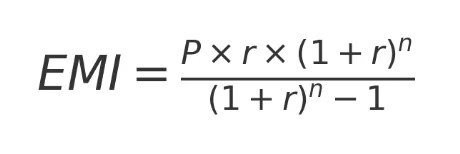
Let’s consider a real-life situation. Suppose you take out a loan of $100,000 to buy large quantities of stock. The bank charges an annual interest rate of 12 per cent, which means a monthly interest rate (R) of 1 per cent, and you agree to pay off the loan over 36 months.
Using the formula, your monthly payment will be $3,321.43. You should now realise that your e-commerce store must make an extra $3,321 in net profit every month to break even on this expansion; if you can’t ensure that extra profit, don’t take out the loan.
7 Fatal Mistakes When Managing Monthly Debt Obligations
Managing debt takes discipline. The most typical ways in which founders ruin their businesses when they try to grow their companies using borrowed money are as follows:
- When it comes to platform fees, founders may calculate their EMI figures without accounting for the extra 2.9% plus $0.30 that payment gateways such as Stripe or PayPal charge on each transaction used to pay the EMI.
- When it comes to tax obligations, you must pay taxes on your net income before you pay the principal on your loan; not setting aside money for the IRS can result in huge penalties.
- Different types of interest often confuse founders, who tend to mix up simple interest with the cost of an amortised working capital loan and, as a result, produce extremely inaccurate cash flow forecasts.
- Neglecting ROAS Decay: As you increase e-commerce ad spend, acquisition costs will rise, and your original ROI will not stay the same.
- Omitting stress tests: Not running stress tests, like a 30-day supply-chain delay, can hide risks.
- Using your personal credit or assets to pay an LLC’s liabilities can pierce the corporate veil and put your personal finances at risk.
- If you agree to a variable interest rate without a large emergency fund in the treasury, a sudden market shift could immediately double your monthly payment.
Aligning Your ROI with Your Working Capital Loan Cost
The only reason for taking out a business loan from a mathematical point of view is when the expected return on investment (ROI) greatly outweighs the cost of the debt; if you are paying 15% per year on the money you borrow, your inventory turnover and your advertising campaigns have to produce at least 30% consistently.
You must account for how quickly your capital moves. If you purchase inventory from abroad, the money is tied up on a cargo ship for two months, and during that time you pay your EMI without earning a single dollar from those goods.
Your cash flow must be strong enough to cover this gap, since debt-financed scaling only works for brands that already have a proven, highly predictable method of acquiring customers. You shouldn’t borrow money to work out your marketing strategy; instead, borrow only to add fuel to a fire that is already burning.
Securing Your Margins to Scale Your E-Commerce
You use leverage to expand your e-commerce business without reducing your equity, but debt has no mercy. Investors may give you a grace period if you miss a quarterly target, but a bank will take your collateral and freeze your merchant accounts.
Treat loan repayments as your most important operating expense, and include them in your daily financial dashboards. Don’t allow your team to raise any overhead costs or software subscriptions unless they first check the debt coverage ratio.
By utilising precise calculators and maintaining a paranoid level of cash flow management, you can use bank capital to dominate your competitors. Just remember: the math will never respect your feelings.