
Once our digital agency had saved up a comfortable amount of cash, I decided to put a small part of our company’s treasury into crypto derivatives. I considered myself a trading genius for shorting XRP and ADA at the top of a local cycle by using 20x leverage. The position immediately made a profit, and I felt like a veteran from Wall Street as I shut down my laptop.
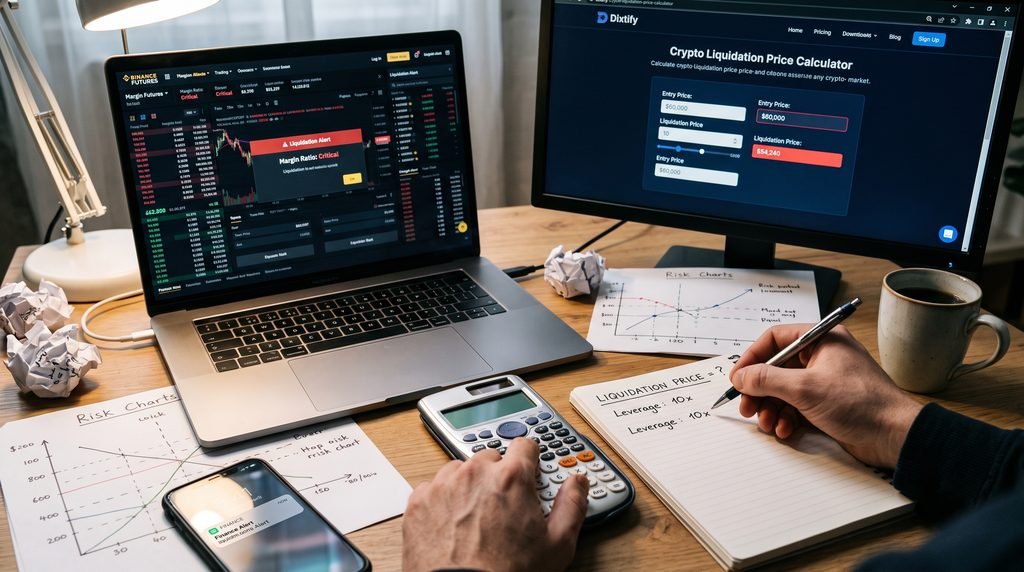
I awoke at 3 AM to a critical margin-call alert from my exchange; during the overnight session there had been a sudden flash pump which had brought the market price dangerously near my liquidation level. I rushed to open my laptop, desperately attempting to work out at exactly what point the equity in my LLC’s account would reach absolute zero.
I soon came to the realisation that I was merely guessing; I had no conception of how the maintenance margin actually related to my particular entry price and leverage multiplier, and it was that one night of panicked confusion which almost caused our agency to lose its entire quarterly tax reserve simply because I didn’t have basic financial modelling skills.
If you’re trading leveraged products and relying on your safety net as a guess, then you’re gambling, not trading; you must have a high degree of mathematical certainty before you even press the buy or sell button. To avoid having the financial heart attack I had, always go through our Dixtify Free Calculator (in particular the one for calculating the internal crypto liquidation price) before entering a position. That is the very tool I created for use in our agency workflow so that we might never be wiped out by unexpected volatility.
The Brutal Reality of Margin Calls and Wiped Accounts
To trade futures is to borrow money in order to artificially increase the size of your market position. If you use heavy leverage, the exchange does not risk losing its own money even if the trade moves violently against you.
Rather, the automated risk engine establishes a fixed liquidation price. As soon as the asset’s mark price reaches that precise figure, an algorithmic system acts immediately. Your position is then closed out at the current market price without your consent.
Your initial margin collateral is taken by the exchange to meet the deficit. The most unfortunate thing is that a great many traders end up being liquidated even though the asset eventually moves in the direction they had predicted; they are “wicked out” as a result of a temporary flash crash since they had not used a precise futures liquidation calculator earlier.
Table of Contents
Why a Basic Binance Futures Calculator Excel Sheet Will Fail You
At the beginning of my career in managing the crypto portfolio of our agency I used a fixed spreadsheet to record all my entry points and entered the leverage manually, guessing my risk thresholds from raw percentages.
It is a huge error. Because the Excel template for a static Binance Futures calculator doesn’t take into consideration real-time funding rates, changing maintenance margins, or the decay of cross-collateralization, your calculations must be dynamic since the crypto market is dynamic.
If you use outdated spreadsheet formulas you’ll end up working out the size of your safety net incorrectly; you have to use an up-to-date Binance liquidation calculator based on code since it takes into account the exact algorithmic rules of the exchange.
The Math Behind It: True Liquidation Price Formula
The system used by the exchanges to calculate your death spiral is based on a particular set of factors which you cannot work out in your head. The main ones are your Entry Price, your Leverage (also known as Initial Margin), and the Maintenance Margin Rate (MMR).
The MMR is a percentage-based tier determined by the exchange according to the total size of your position. In the case of a standard Isolated Margin Long position, the basic formula is as follows:
$$\text{Liquidation Price} = \frac{\text{Entry Price} \times (1 – \text{Initial Margin Rate} + \text{Maintenance Margin Rate})}{1}$$
Let’s look at this with a practical calculation. Suppose you purchase an asset for $60,000 on 10 times leverage; your initial margin rate is 10% (this being 1 divided by the leverage multiplier of 10).
Suppose that the maintenance margin rate for your particular position tier is 0.4 per cent; your calculation is then: $60,000 \times (1 – 0.10 + 0.004)$.
The liquidation price is therefore precisely $54,240; should the value of the asset reach $54,240 you will have lost all of your original investment. It is not advisable to use mental arithmetic in situations involving corporate funds; instead you should use a specialised liquidation price calculator to ensure complete accuracy.
Factoring in Hidden Trading Costs and Funding Rates
Your exact liquidation level is never a fixed figure since it shifts in your favour over time due to unseen holding costs and platform trading fees; every eight hours perpetual contracts charge a funding rate in order to balance the amount of money held on the long and short sides of the market.
When the general market is strongly bullish, you will have to pay a continuous fee to short sellers, and these funding fees are taken directly from the margin collateral you have available. Since your margin decreases gradually, your liquidation level will move nearer to your entry price.
In addition, when you open or close a leveraged position, you have to pay maker and taker fees. In order to protect your capital, you should use a reliable Binance futures fees calculator to take into account these exact deductions. If you hold a highly leveraged position for several weeks, the fee decay will entirely change your original margin calculations.
Tracking Your Upside Without Ignoring the Downside
Beginner traders mostly concentrate on the amount of money they can earn. Instead of taking their level of risk into account, they spend hours planning out ideal situations using a future trading profit calculator.
Although profit mapping is important, capital preservation should always be the top priority since you can’t grow a digital business or a trading account if you regularly cause your entire portfolio to be wiped out. All professional traders should have access to a full crypto futures calculator which displays the maximum possible gain and the worst-case liquidation situation together.
Isolated vs Cross Margin: Structuring Your LLC’s Risk
You should first get a clear understanding of how your collateral is set up on the exchange platform, since confusing your margin modes would be absolute financial suicide in the case of corporate accounts or LLCs.
With Isolated Margin, a definite, limited amount of capital is allocated to one trade; if you are liquidated, you lose only the exact dollar amount associated with that position. In the case of Cross Margin, the whole balance in your futures wallet is used as shared collateral to avoid liquidation on your open trades.
Should a major loss take place while you are using Cross Margin, one bad trade could empty all the dollars in your account. You should always use Isolated Margin to isolate your risk.
Practical Steps to Survive High-Leverage Trading
- Set hard stops: it is never acceptable to enter a trade without first setting a hard stop loss at a distance of at least 2% from your actual mathematical liquidation price.
- Limit your leverage: If you hold positions overnight, keep your leverage strictly under 5x because the market doesn’t sleep, and overnight volatility can destroy your capital.
- Audit Your Margin Mode: Double-check your margin settings every single time you open a new ticket. A simple misclick from Isolated to Cross has bankrupted thousands of traders.